Showing posts with label Gospel of Luke. Show all posts

Friday, January 4, 2013

What Then Shall We Do?

File:El Greco - St. John the Baptist - WGA10548.jpg
El Greco - St. John the Baptist
Ah- the new year has begun! At least for the world, Christmas is over. (In the Church, we finish up our celebration this week with Epiphany Sunday.) Our decorations are packed away; our homes are less cluttered; we have returned to our "normal" routines. We are settling in for the long journey of winter - the season where nature rests and anticipates the new burst of life that is spring. 

From my study window at home, I see the forest bare. In the winter, I can see the tiny bit of lake behind our house that is otherwise hiding from view. Such a perspective reminds me that winter is a good season. It gives us a chance to see more clearly and take stock more deeply.

That may be something of what the Gospel of Luke will do for us this winter. At Seneca Presbyterian Church, we will be "with Luke" until the Sunday after Easter, which this year comes very early; only a few weeks into spring. Luke is a Gospel that doesn't hesitate to "lay bare" the realities of our lives and of our souls. It speaks the truth, but it is a truth spoken in love, so it is a truth we can hear and receive.

We see evidence of Luke's reality in the story of John the Baptist, the story that greets us this week. John is the gatekeeper of all the Gospels. In each one of them, we cannot get to Jesus without passing by John. I find Luke's portrait of John the most fascinating and rich of all. In Luke, John truly does hold center stage. (Just take a moment to read Luke 3:1-22.) We hear his preaching and his dialogue with the crowd. We hear his challenge and his fire. Just like the crowd, we are drawn to him - amazingly so. And just like the crowd, we should be changed by him: honestly confessing and tangibly embodying the reality of our salvation.

What then shall we do? It is the crowd's response to John's preaching. 

As we journey through Luke this winter, with the Narrative Lectionary as our guide, can we can make the crowd's question our springboard? 

  • ·         What does a disciple do? 
  • ·         What does a disciple think and ask? 
  • ·         What does a disciple feel and believe?
  • ·         Who does a disciple turn to? 
  • ·         What does a disciple expect?
  • ·         What does a disciple receive? 
 Our journey through Luke should change us if we listen intently and take what we hear to heart and to life. How? By helping us to see and understand and experience the path of authentic discipleship. John’s message and baptism provide just the beginning to that amazing journey of transformation. Jesus will provide us with the follow up challenge. Let's be ready to hear it. 

I invite you to follow along each week, reading what lies between the Sundays so that in the end, we we have taken the complete journey. A schedule is posted under the Reading Plan tab at the side of the page. For this week, the assignment is simple. Read Luke 3:23-4:13.


Friday, December 14, 2012

A Journey with Luke


Beginning this Sunday, we at Seneca Presbyterian Church will be making a journey through the Gospel According to Luke. The Narrative Lectionary will be guiding us. The journey will take us through Easter. It's an appropriate journey to take on these Sundays. We will remember the life of Jesus in the days between the time we celebrate his birth and the time we remember his death and celebrate his resurrection - his re-birth and our own. On this particular journey, Luke will be our teacher and our guide.

 Each of our Christian Gospels (Matthew, Mark, Luke, and John) is unique and I am deeply grateful for that fact. I find it to be divine endorsement of the diversity of faithful expressions within the one affirmation of faith that all Christians share. Jesus Christ is Lord. He is the divine Incarnation, God with us, present with us on earth and in our lives on earth. In my own limited understanding of all the world's religions, that seems to be the unique contribution of Christianity. The world is not a place we seek to escape; it is the creation of God that humanity has spoiled and God is in the process of redeeming. Those of us who choose to follow His Son and to claim the name Christian are called to be partners with God in that re-creation.

Luke's Gospel was written for a world of both Jews and Gentiles. He wanted to show how the promises of God to Abraham had been fulfilled in the coming of Jesus of Nazareth, the promised Messiah. He claims to be writing an "orderly account" for his friend Theophilus, a name that means “lover of God” (Luke 1:1-4). He anchors his story in the context of world affairs, telling us that “this was the first registration and was taken while Quirinius was governor of Syria” – to quote a familiar yet challenging line from Luke chapter 2.

Each Gospel was written for and in a specific community of Christian disciples. Yet because of their universal appeal, we don’t know just where each of them was written. That is one of the fascinating aspects of Gospel study. As we journey through Luke, we will discover clues about the unique make-up of Luke’s community and their unique challenges and gifts. That fact reminds us that the Gospels are not biographies of Jesus, especially as we understand that literary form. They are, in a sense, extended sermons whose purpose is to tell the Gospel story and bring us to faith, and once we claim that faith, to deeper discipleship.

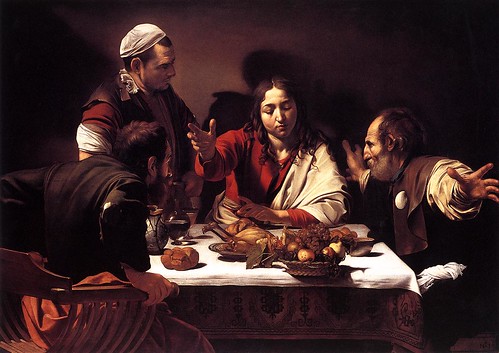
Luke has blessed us with a much –loved Gospel story. Without Luke we would not know Zacchaeus, the Good Samaritan, the Prodigal Son, Elizabeth and Zechariah, Simeon and Anna, and two disciples who walked the road to Emmaus with a stranger who ended up being the resurrected Lord. May that Lord and Savior walk with us as we journey with Luke.

Several years ago, while preaching on the baptism of Jesus as interpreted by Luke, I found that text inviting me into the entire Gospel. If you want to know more about Luke, I've posted that sermon as the page "A Year with Luke." You can access it by clicking on the bar at the side of this page.

I invite you to deepen your own journey by reading the entire Gospel of Luke through from beginning to end, in one sitting if possible. As you do, ponder what it means to be a disciple of the One whose birth we celebrate in these days.