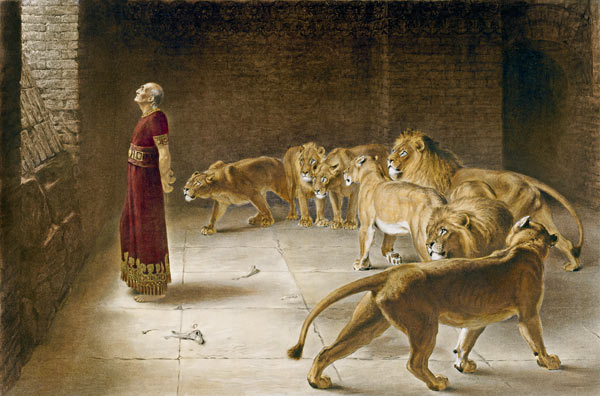
 This Sunday at Seneca Presbyterian Church, the Narrative Lectionary will lead us to a consideration of the story of Daniel in the Lions' Den. Now, if you're checking the calendar and noticing that Sunday is December 2, and also checking our church calendar to discover that we are celebrating our annual Christmas Dinner this week, you might wonder what Daniel and lions have to do with Christmas, or better said, with Advent, the season of preparation for Christmas.
 The book of Daniel is all about living in exile. The kingdom of Judah had been destroyed. The very best and brightest of its citizens had been taken into exile by the nation of Babylonia. Everything that gave life meaning had been taken away: land, Temple, and king. The prophets had said it was because of their unfaithfulness. The exile was God's great act of discipline - an act of love that embodies teaching and learning and growing in faith.
Our Hebrew brothers and sisters needed time to figure it all out. They had to learn how to live faithfully in a foreign land. They had to craft ways of worshiping God without the glory of God's Temple and festival celebrations. They had to re-discover their faith.
The wonderful stories that make up the first six chapters of the book of Daniel speak of faithfulness to the ways of God even when those ways seem foolish, and even when they are dangerous. Our heroes - Daniel and his friends Shadrach, Meshach, and Abednego - are wise and faithful and brave. They rise to power without compromising their faith. When threatened by those who are jealous of their success, God protects them even in the face of certain death. And the kings of Babylonia and Persia come to believe in the God of Daniel - the almighty One, the King of all nations.
There are many in our day who believe that Christianity is on its way into "exile" as well. A Gallup Poll released last July says that only 44% of Americans have a great deal or quite a lot of confidence in "the church or organized religion." That rate has been falling steadily in the last thirty years. However you may interpret the fact, America is not the "Christian nation" we used to be. We see something of that in the drive to secularize Christmas. We love the holiday but many have problems with the faith from which it comes. So perhaps the story of Daniel and his challenge to maintain his faith in the midst of exile presents a learning opportunity for us.
As we prepare to contemplate Daniel and lions, consider:
- How do you experience the world's holiday of Christmas?
- How does that differ from your quest to find meaning in what we believe as Christians about Christmas?
- What are the most significant traditions, meanings, and truths for you?
- If all of those traditions were taken away, how would you still believe and remain a faithful Christian?

